

Circles of Excellence: getting in touch with your inner resources
17th October 2023
Many years ago, I did my first Neuro-linguistic Programming (“NLP”) practitioner course with Willie Monteiro and Eric Robbie. It took place in York over a number of weekends,. The course was great and I remember thinking after the first weekend, taught by Willie Monteiro, that I had learned more from that one weekend than I had learned from an entire year long counselling course!
If you are not sure what NLP is, I think of it as a set of principles for exploring and improving the way we make sense of our experiences, communicate with ourselves, and communicate with other people. The aim of applying these principles is to help us to develop ways of thinking, relating to other people, and doing things which enable us to maximise our ability to live happy and successful lives.
Using these principles, the original developers of NLP created many effective techniques for changing the way we think and feel so that our experiences and the challenges we face become opportunities for personal growth.
One of the techniques is the “Circle of Excellence”, which Willie showed us right at the beginning of the NLP practitioner course. It’s a simple process which enables us to apply positive emotional states which we have gained from previous experiences to other areas where we need them now.
It is an example of putting into practice the NLP principle that:
You have in your history all the resources you need to deal with life’s experiences and flourish.
So, here is a Circle of Excellence technique that you can learn to use for yourself. You can use this process to develop all sorts of positive states – like curiosity, motivation and being open to learning – which is no doubt one reason that Willie taught this process at the beginning of the course. But in this post, I will use the example of confidence as the state we want to cultivate.
Read through all the instructions a couple of times before having a go at the process. It may look like there are a lot of steps, but that is only because I have broken the instructions down into small and easy chunks.
The process is one which you have unconsciously used many times in your life, so you are naturally good at it!
1. Think of a situation where you would like to be more confident
Let’s call the situation you choose, “situation A”. If one doesn’t come to mind, choose a situation where you are already confident, and would be happy to be even more confident!
2. Think of a cue to trigger the feeling of confidence
Like an actor stepping onto a stage, you need to have the feeling of confidence right from the start of “situation A”, so think of a cue to trigger off the feeling of confidence that will be there just before “situation A” or right at the beginning of it: it could be something like the sight of the door of the room where you are going to be; it could be seeing a particular person; it could be hearing someone’s voice.
3. Think of a time when you had that feeling of confidence
The chances are that you can remember some time in the past where you had just the confidence you would like to have. It doesn’t have to be the same sort of situation as situation A. For example, if situation A is giving a presentation, you might have experienced just the right feeling of confidence when enjoying a conversation with a friend.
If a time doesn’t come to mind when you felt that confidence, you can use someone else as a role model. Think of someone you know who you have seen displaying just the right degree of confidence – it could be a friend, or someone you have seen in the media.
4. Imagine a coloured circle about three feet in diameter on the floor about two feet in front of you – a bit like a spotlight on a stage.
What colour is it? Whatever colour comes to mind is perfect – I have used a yellow circle in my illustrations below simply because I like the colour yellow and it looks good on a computer or phone screen.
5. Imagine in the circle a life size image of yourself (or your role model) displaying just that confident way of being
You don’t have to have a clear image, but if you can imagine or have a sense of a clear, bright, colourful and moving image with accompanying sound, that it is even better.
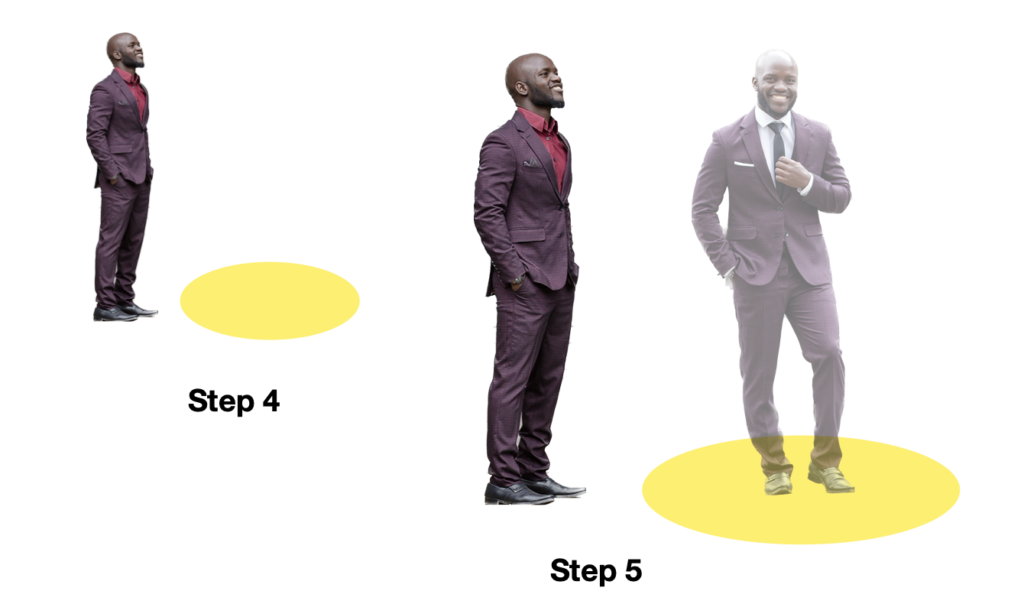
6. When you have that image, step into the circle and into the image of yourself (or your role model)
Take a few moments to experience what is like to feel that confidence in your body. Imagine you are relating to other people in that confident way. Feel how you are standing, the expression on your face; hear how you are speaking; see and hear other people relating to the confident you.
7. Step out of the circle, leaving those feelings of confidence in there.
8. Think of the cue for where you would like to have those feelings of confidence and as you do so, step back into the circle and experience again all the positive feelings from step 6.

9. Test your results.
Step out of the circle, leaving the positive feelings in there. Distract yourself by looking around the room or humming a line or two of a song. Take a deep breath and let it out.
Now think of that situation where you wanted to feel more confident. The chances are that you will feel more positive about it.
10. Repeat steps 4 to 9 four or five times
Repetition will help your unconscious mind to learn the process.
11. Congratulate yourself for having a go!
If after doing this you are not sure if there is a change, take a break and have another go later on. When we learn any new skill, the times it does not work as intended are as much a part of learning as the times it does!
Have fun practising and learning!
I hope that you have found this interesting and helpful. If you have, why not sign up to my free Suggestions newsletter which gives more information and tips about personal development and therapy. It comes out about every three weeks or so. To sign up, just click on the link below. You just need to give your name and email address – and needless to say, I won’t share your details with anyone else.