

Polyvagal theory: understanding, managing and overcoming stress
13th February 2025
Introduction
We all go through difficult experiences in life, but why is it that our responses can be so different in kind? And why is it that we don’t have control over our own response to stress? Sometimes talking to others helps; sometimes we don’t want to talk; sometimes we get fearful and angry; sometimes we lose interest in life or become depressed.
One approach which seems to provide answers to these questions is Polyvagal theory, developed by Stephen Porges, professor of psychiatry at the University of Carolina. It also gives guidance on how to become more resilient ourselves, and help others deal with stress and trauma. Many people who suffer from anxiety or trauma, or work in the field, would say that it fits in exactly with their experience. I think that you too will find that it makes sense.
So if that sounds like something worth finding out about, read on!
Why “Polyvagal” theory?
This way of thinking about stress and trauma is called “polyvagal” because it is concerned with the vagus nerve, a major nerve connecting the brain with the organs of the body, and the prefix “poly” (meaning many) signifies that the vagus nerve has more than one function.
So what exactly is the vagus nerve?
The vagus nerve is a bundle of nerve fibres making up the largest nerve in the human body. It connects the brain with most of our internal organs and enables the brain to know the state of our body.
Polyvagal theory focuses on two pathways within the nerve:
- an old pathway, the dorsal vagus, which we inherited from our reptilian ancestors, and which regulates the function of the organs below the diaphragm; and
- a new pathway, the ventral vagus, which evolved in mammals, and which regulates the organs above the diaphragm, namely the heart and the passageways into the lungs, and is, most importantly, also linked to the nerves which regulate the muscles of the face, throat and ears.
The vagus nerve therefore has input into such varied activites as heart rate, the function of the digestive system, facial expressions, hearing, speaking and voice tone.
The role of the vagus nerve in the autonomic nervous system
The vagus nerve is an important part of the autonomic nervous system, the part of the nervous system which controls bodily functions outside our conscious control – like our heart beat and the functions of our organs.
The autonomic system is made up of two systems: the sympathetic nervous system, and the parasympathetic nervous system which work in a complementary way to maintain the body in a healthy balanced state.
The sympathetic nervous system can be thought of as mobilising the body, like the accelerator in a car. It speeds up the heart beat when we stand up, for example. Another function of this system is the “fight or flight response” – the changes which occur when our brain perceives that we are in danger and which evolved to help us to fight or run away.
The parasympathetic system, on the other hand, dampens things down and can be compared to the brake pedal in a car. You can experience the damping down effect of the parasympathetic system quite simply: just take a deep breath and hold it for a second and then slowly let your breath out. The feeling of relaxation as you breath out is your parasympathetic nervous system at work. The vagus nerve is an important part of the parasympathetic nervous system.
So what is polyvagal theory?
We humans are social animals and from birth have an instinctive need to connect with others. The ability to feel safe is an essential pre-requisite to fulfilling this need.
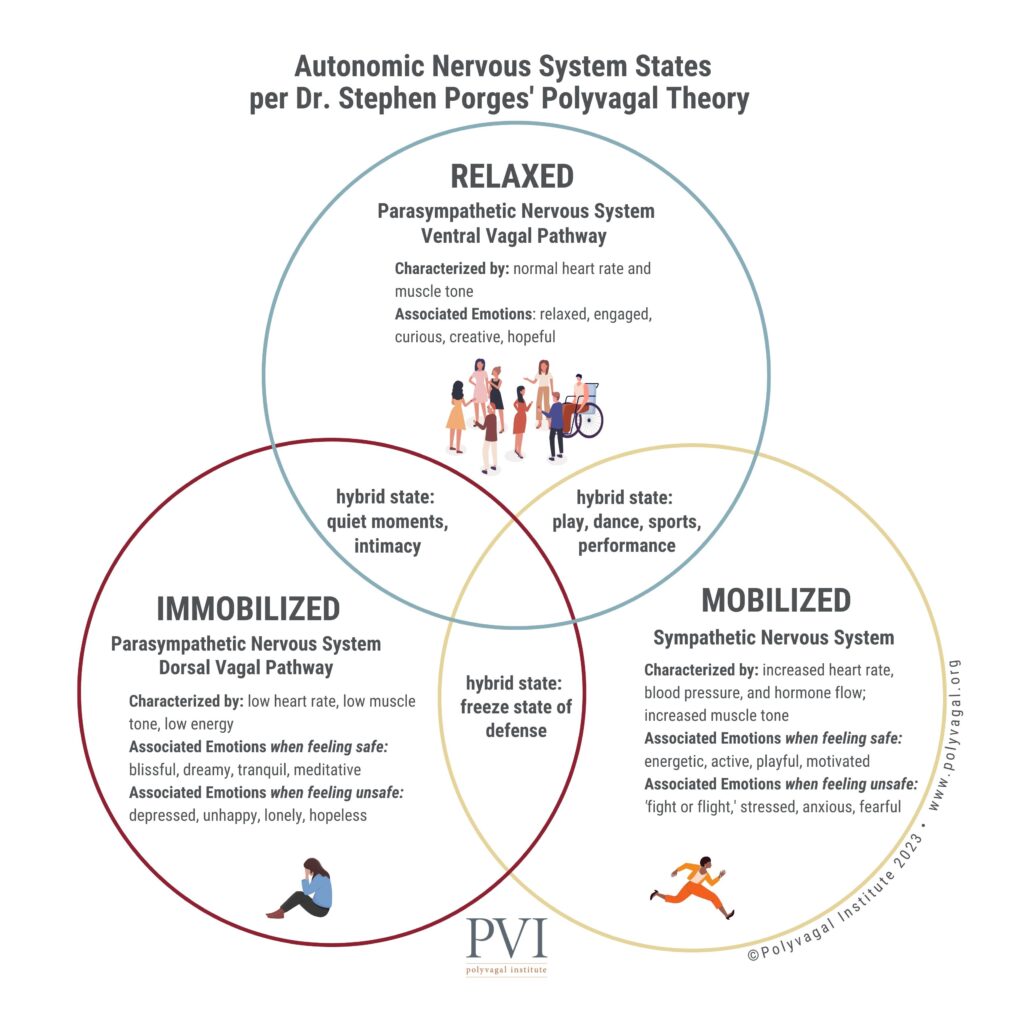
When we feel safe, the mammalian or ventral vagal system is on-line. This can be thought of as the “social engagement system”. Being connected to the heart, muscles of the face, voice and hearing, this is the system through which we communicate to others (eg by expressions and voice tone) that we feel safe and are safe to approach. Our heart beat is regular, our breathing full and our voice tone melodic. We are able to connect with others, and to regulate our feelings through social contact. In this state we feel happy, interested in life and feel the world is safe.
When we are stressed or feel unsafe – which can be triggered by current events or memories of previous experiences – the sympathetic system is engaged. If our body/brain perceives that we are in danger, the fight or flight response is triggered, overriding the social engagement system, and mobilising us to take action in order to reach a state of safety. In this state we feel angry and fearful, the world feels dangerous, we develop “tunnel vision” for the source of the danger, and we interpret things which would not otherwise bother us in a negative way. Consequences of being in this state might include distress in relationships and stress related illness.
If the fight or flight response doesn’t help us to reach safety, the dorsal vagus system takes over and shuts everything down. Many different kinds of animals literally appear dead as a way of achieving safety (I have seen this with newts in the garden!). In humans, this response manifests in dissociation, depression, drug taking or lack of energy for daily living.
The nervous system activates these responses – which evolved to protect us – without any direct conscious input or control. In fact, we might not even be aware we are feeling uneasy, anxious or depressed or why, and Stephen Porges coined the word “neuroception” as a term for the process whereby our nervous system perceives things without our conscious awareness.
In a typical day, we can move to and fro through each of these ways of being, depending on our experiences, but ideally we will spend as much time as we can in the social engagement system of the ventral vagus system.
Polyvagal approaches to increase resilience
Fortunately, we are able to take conscious steps to activate the ventral vagus system.
If someone is anxious or depressed, simply learning about polyvagal theory can be very empowering in helping them to understand what is going on for them and what they need to do to change their internal state and move into the social engagement system.
Things we can do by self-help:
- engage in social activities with other people, especially fun ones or play;
- listen to calming music – especially involving the sound of human voice;
- slow deep breathing exercises – they send messages to the brain to relax;
- singing, humming or playing a wind instrument – which all entail extended out breaths – especially with others;
- having a massage;
- meditation;
- yoga;
- cold showers;
- self-havening.
If someone needs professional help, simply talking to someone in a safe environment can really help. Approaches like havening, hypnotherapy or NLP, which have specific techniques for changing someone’s emotional state in a positive direction are particularly helpful.
To find out more
If you are suffering from stress, anxiety or trauma and would like to find out more about how hypnotherapy, NLP and havening can help, please get in touch. I offer a free, no obligation twenty minute consultation which can take place in person, or by telephone or video call. To get in touch, just click on the button below.