
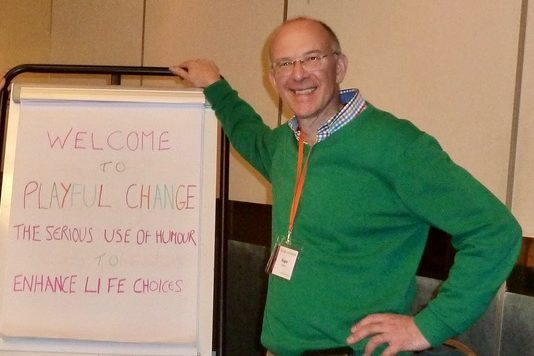
Playful Change
27th July 2021
The Serious Use of Humour to Enhance Life Choices
“At the height of laughter, the universe is flung into a kaleidoscope of new possibilities”. Jean Houston
Over recent years more and more research has indicated that playfulness and humour enhance learning, creativity, relationships and wellbeing.
Playful Change is an approach to using humour and a playful attitude in coaching, therapy and counselling developed by Phil Jeremiah over many years of professional experience as a psychiatric social worker. He describes Playful Change as “the serious use of humour to enhance life choices” citing as his main influences Milton Erickson, Victor Frankl, and Frank Farrelly – the last of whom he studied with for many years.
But what is Playfulness?
There are many different aspects to playfulness, but most people would probably agree that the description of someone who is playful would include some – and sometimes all – of the following adjectives:
- happy, optimistic, cheerful, joyful, positive, relaxed, enthusiastic
- spontaneous
- mischievous, clowning, teasing
- creative
- whimsical, silly
- expressive
- funny, humorous.
Such playfulness can be experienced in many ways: in the simple pleasure of bodily movement – like hopping, skipping, jumping or dancing; in playing with objects, toys or musical instruments; in playing games; in the banter of close friends; in pretend play (eg dressing up); in story telling; or in creative use of the imagination.
Play and humour are by their very nature something we enjoy. They are contagious and create rapport with others. To be in playful rapport with others is a pleasurable and affirming experience.
Whilst we tend to play less as we get older, and to play in less physical ways, recent research on brain plasticity indicates that playfulness, like mindfulness and compassion, is a state which we can develop through practice. There is some truth to the saying:
“We do not stop playing because we grow old. We grow old because we stop playing.”
So how can humour and playfulness be part of a coaching, counselling or therapy session – where seriousness and even earnestness is often the order of the day?
The first thing is to get the client’s informed consent to using humour and play. “You want to change. Other things have not helped. Let’s try Playful Change!”.
If the client is “up for it”, the practitioner sets up “a bubble of possibility” in which the practitioner will act as “playful coach” for perhaps twenty minutes, and at the end of the session they discuss what arose during the session.
Humour is an essential ingredient – but it is not about delivering a series of “one liners” to the client. Nor is it humour at the client’s expense. It is humour with a twinkle in the eye which reminds the client of their strengths and resourcefulness. It is humour born of a playful attitude and out of a deep respect for and rapport with the client.
Paradoxically, the practitioner does not try to help the client and the conversation in the bubble may well cover all kinds of unexpected subjects and seem irrelevant to the client’s problem, but throughout the practitioner communicates the following ideas (among others):
- you are the expert in your life
- you are capable of making decisions about your life
- you are capable of changing
- you will change and grow in response to a challenge
- you are capable of far more than you think
- you can find a way of resolving or dealing with the problem at hand
Against logical expectation, the seemingly irrelevant conversation changes things – and can do so very quickly. In the Playful Change bubble, issues, resources and solutions rapidly emerge which may never have emerged in a lifetime of conventional counselling or coaching.
The approach is suitable for use with – and has been used with – all kinds of issues including: phobias; smoking cessation; relationship difficulties; bereavement; setting directions in life; work problems; confidence building; anxiety.